



Project Location:
Sakhalin State, Russia
Project Owner
: Sakhalin Energy Investment Company Ltd.(SEIC), a consortium of Royal Dutch Shell(55%), Mitsui & Co., Ltd.(25%) and Mitsubishi Corporation(20%).
Finance Institutions:
[Phase 1] Export-Import Bank of Japan (now the Japan Bank
for International Cooperation, JBIC), European Bank for Reconstruction
and Development (EBRD), Overseas Private Investment Corporation
[Phase 2] JBIC
Total Operation Costs
: Originally said to be JPY1.2 trillion, but SEIC announced the costs to have doubled to JPY2.2 trillion in July, 2005.
Project Overview
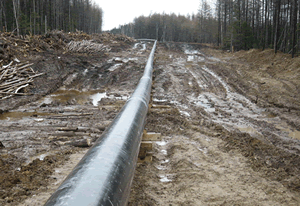
: The project plans to extract petroleum and natural gas from the northeastern shore of Sakhalin. The first phase has been completed and has started production in 1999. Uses an oil-rig called Molikpaq to extract crude oil, and transports it by tanker to Japan and Korea. However, transport by tanker is impeded by ice during the winter, and there is a plan to construct an 800km buried pipeline on land for the second phase of the project. There are also plans to construct an additional two platforms, a submarine pipeline, a processing facility on land, and a petroleum exporting terminal and liquid natural gas plant on the southern part of the island.
There are six projects from "Sakhalin I" to "Sakhalin VI" planned for development on and around Sakhalin Island, but the two currently under development are "I" and "II." In the second phase, petroleum production was planned to start at the end of 2006 and natural gas production from 2007, but SEIC announced in July, 2005 that the projected start date of production is likely to be delayed until the middle of 2008. Estimated extractable petroleum is 100 million tons, extractable consensate is 40 million tons, and extractable natural gas is 400 billion square meters.
Impacts on the lives of indigenous people of Sakhalin State, wildlife, and also fishery resources due to this development are apprehended. Migratory birds that spend the winter in Hokkaido, and large scale oil spill accidents are a concern.
Involvements with Japan
Involvement of Public Funding Institution: Export-Import
Bank of Japan gave a loan of US$1.16 million for phase one of the
project. JBIC, along with a group of private banks, signed a US$5.3
billion loan for phase two.
Involvement of Japanese Firms: Mitsui & Co. Ltd. And Mitsubishi Corporation invest in the project operator, SEIC. The percent investments for the first phase were Marathon Oil Corporation(37.5%), Shell (25%), Mitsui & Co. Ltd. (25%), Mitsubishi Corporation (12.5%) became Royal Dutch Shell(55%), Mitsui & Co., Ltd.(25%) and Mitsubishi Corporation(20%) with the withdrawal of Marathon Oil in 2000.
Geological Connections: Sakhalin Island is only about 40 km from Hokkaido, and environmental and social impacts to the eastern shores of Hokkaido, including the world heritage Shiretoko, is a cause for concern.
Timeline
1984-1986
Oil and gas deposits are discovered on the northeastern continental shelf of Sakhalin Island. (The mainly oil Piltun-Astokh deposit, and the mainly gas Lunskoye deposit)
Apr1994
Sakhalin Energy Investment Corporation (SEIC) is founded
June
Production Sharing Agreement (PSA) is signed between the project operator SEIC and the Russian Government and Sakhalin State Administration.
June1996
Begin petroleum deposit assessment for the Piltun-Astokh deposit.
Aug1998
Arrival of Molikpaq
July1999
Start production of crude oil at Astokh deposit
Dec2001
Public hearing for the second phase development held by SEIC
Feb2002
NGO Sakhalin Environment Watch holds public hearing
Sept
SEIC hands in Technical and Economic Substantiation of Construction (TEOC) which includes the EIA to the Russian Government
first half2003
Environmental, Social and Health Impact Assessment (ESHIA) disclosed
June
Russian government approves TEOC, requests loans to JBIC and EBRD
July
Japanese Society of Zoo and Wildlife Medicine presents a statement showing concern over the impacts on wildlife.
Sept
SEIC holds project explanation meeting
in Sapporo and Tokyo.
Ministry of Environment Japan suggests a joint research of Stellar's
Sea Eagle and Dunlin to Russia at the Japan-Russia meeting for
the protection and research of migratory birds.
Oct
SEIC dumps about 150 square meters of dirt dredged for the construction of a plant into Aniva Bay
Jan2004
Japanese wildlife specialist inspects the environmental impact assessment (EIA) created by SEIC
Feb
The Hokkaido government presents a letter to SEIC requesting consideration for the environment
Apr
The president of EBRD shows discontent with the response from SEIC and the current condition at the annual general meeting
July
EBRD and JBIC hold an environment related opinion exchange meeting concerning Sakhalin II at Tokyo and Sapporo
Aug
The International Union for Conserving Nature (IUCN) establishes an independent panel to research the impacts on the western gray whale
Sept
Dredging ship contracted by SEIC is stranded near the shore of Kholmsk due to a typhoon. 200 tons of heavy oil is spilled
Oct
JBIC sets up an environment related forum for Sakhalin II phase 2.
Jan2005
Indigenous people of Sakhalin block road in protest of oil and gas development
Feb
IUCN independent panel publishes the report on western gray whales
Apr
Sakhalin citizens and NGO protest
against Aniva Bay pollution
SEIC announces change in submarine pipeline route
May
SEIC admits to insufficient management of contractor of pipeline construction
June
Indigenous people of Sakhalin once
again block road in protest of oil and gas development.
European Bank for Reconstruction and Development (EBRD) announces
postponement of funding for environmental reasons.
Dec
Supplementary EIA disclosed in English and Russian
Jan2006
Sakhalin citizens and people connected to the fishing industry protest to health and fishery damage in front of the LNG plant
Feb-Mar
Japanese translation of the supplementary EIA disclosed
Apr
SEIC announces first five year plan
(2006-2010) of the indigenous people development plan.
Japanese Wildlife Researcher announces "Report on the Investigation
of the Supplementary EIA"
Sept
Natural Resource Department of Russia decides on revocation of phase 2 construction approval due to violation of environment laws (not issued)
Dec
Gazprom acquires majority share of Sakhalin II
Jan2007
EBRD stops consideration of loans with change in project operator
Mar2008
US-EXIM and ECGD stops loan considerations
June
JBIC and a group of private banks signs agreement to loan JPY5.3 billion for Sakhalin II phase 2
Major Points of Concern
Concerns Over Endangered Species
-There are concerns over serious impacts on precious wildlife including
the Stellar's Sea Eagle (passes winter in Hokkaido. A natural monument,
and listed in the Japan-Russia migratory bird treaty and preservation
of species law) and western gray whale (approximately 100 individuals
left. Designated as an endangered species by the IUCN, Fisheries
Agency, and the Mammalogical Society of Japan.) from development
and oil spills. Measure to avoid such impacts are not sufficient.
-Japanese wildlife specialist points out mistakes and insufficiencies
in the EIA created by SEIC.
Measures against Oil Spills
-Serious impacts on fishery resource that support the local economy
of Hokkaido and Sakhalin, and damage to the local society due to
oil pill accidents.
-Many problems such as measure against oil spills due to earthquakes,
measures against oil spills when the sea is frozen, and impacts
of dispersion agents on the natural environment remain because the
oil spill response plan (OSRP) for facilities to be constructed
during phase 2 will not be complete until just before the start
of operation.
-Problems with the reporting structure in case of tanker accidents
and smooth cooperation between Russia and Japan.
Pipeline
-Concerns of land erosion and water pollution due to construction
as the 800km long land pipeline is buried crossing over 1000 important
rivers and streams for salmon and trout habitat.
-Concerns of damage and oil spills due to earthquakes as the pipeline
route crosses 22 active faults.
Dredging and Marine Dumping in Aniva Bay
-Damage to fishery resource due to dredging and dirt dumping accompanying
the construction of LNG plants and crude oil terminals.
-Insufficient consideration of alternative locations for dumping.
Social and Economical Impacts
-Serious impacts on the lives of the indigenous and local people.
-Inequality in the production sharing agreement (problems to the
economical profits of Sakhalin)
-Violation of Russian laws
-Insufficient information sharing and discussion with stakeholders